On Saturday, May 4th, an e-recycling and shred event will be held at New Britain Township (207 Park Ave) that is open to Borough residents.
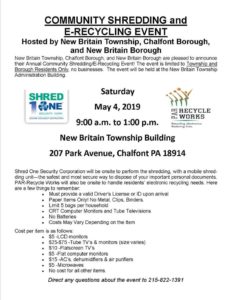

On Saturday, May 4th, an e-recycling and shred event will be held at New Britain Township (207 Park Ave) that is open to Borough residents.
Nicole Percetti, the Borough’s tax collector, will be in the Borough administration office to collect County/Borough property tax payments in person on Tuesday, April 23rd from 2:00 to 4:00 PM. Please contact Nicole directly with any property tax related questions @ 215-822-2930 or you can email Nicole at newbritaintax@gmail.com
Please note that the Borough’s administration office at 45 Keeley Avenue is undergoing parking lot construction. For the remainder of this week, should you need to come to the office, please park across the street at Burkart Hall (56 Keeley Avenue) and walk over to our office. We apologize for any inconvenience and we thank you for your patience.
The Pennsylvania Department of Environmental Protection announced on March 15, 2019 that the New Britain Borough Nature Preserve Committee is one of its recipients for the 2019 Governor’s Award for Environmental Excellence.
According to DEP, they “…evaluated projects for their degree of environmental protection, innovation, partnership efforts, economic impact, consideration of climate change, and sustainability and results achieved.” The Nature Preserve Committee received the award, according to DEP for “Habitat restoration at the nature preserve—Volunteers carried out a three-year project to clear invasive species; install nesting boxes; redesign trails to prevent erosion; conduct a soil study; install benches; and plant 386 native trees, 119 native shrubs, and wildflowers.”
Councilmember Tom Price, who serves as Council Liaison and Committee Chair stated, “It’s an honor for our committee to be recognized with this award for all the work we’ve been doing in the Preserve over the past several years. I’m very grateful to our committee members and all the other volunteers who have helped us carry out this long-term and on-going habitat restoration project.”
This is the second year in a row that the Borough’s Nature Preserve Committee has won a prestigious environmental award for its restoration efforts. In 2018, the Committee was the recipient of the Land Ethics Award given out by Bowman’s Hill Wildflower Preserve.
The Wilma Quinlan Nature Preserve, established in 1971, is managed by an all-volunteer committee of Borough residents. The committee holds regular volunteer work days at the Preserve and meets on the second Monday of each month at 7:30 p.m. at 45 Keely Ave., New Britain, PA.
For more information on the Nature Preserve and the Committee’s restoration work, please visit:
https://www.newbritainboro.com/committees/nature-preserve-committee/
Covered Bridge Park Summer Camp is no longer being run by New Britain Borough. For all camp questions and/or registrations, please visit New Britain Civic Association’s website www.newbritaincivic.org or call them @ 215-345-8750.
 New Britain Borough’s Historic Preservation Committee will be hosting local author, Carl LaVO, to speak about the thrilling history surrounding Bucks County’s own “Doan Gang.” Please join us @ 7:00 PM on April 8, 2019 at Lenape Valley Presbyterian Church located at 321 W Butler Avenue. This event is free of charge.
For seating purposes, registration for this event is required for admission. Please register using the form at the bottom of this page or by calling the New Britain Borough administration office at (215) 348-4586.
Guest speaker, Carl LaVO, a retired news editor and author of five books, is a weekly local history columnist for the Bucks County Courier Times and The Intelligencer newspapers and author of his newest book, Bucks County Adventures. His books will be available for purchase and signing at the event.
The Doan Gang outlaws, also known as the “Doan Boys” and “Plumstead Cowboys,” were a notorious gang of brothers from a Quaker family most renowned for being British spies during the American Revolutionary War.
The Doans were Loyalists from a Quaker family of good standing. The “Doan Boys” reached manhood at the time of the American Revolutionary War. Growing up in Plumstead, Pennsylvania, the Doans excelled athletically. The Doan gang’s principal occupation was robbing Whig tax collectors, and horse theft. The gang stole over 200 horses from their neighbors in Bucks County that they sold to the Red Coats in Philadelphia and Baltimore.
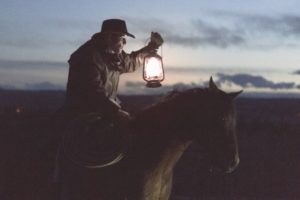 The Friends Meeting House’s cemetery in Plumsteadville is protected by a field-stone wall that runs around its perimeter. Levi and Abraham Doan were buried just outside this wall because the pacifist Quakers refused to bury militants within their graveyard (a veteran of the Civil War is likewise buried outside the graveyard perimeter). The graves are adorned with their original native brownstone headstones which bear no inscriptions, following the Quaker practice at the time of their death, as well as newer headstones that identify them as outlaws.
(Resource, https://en.wikipedia.org/wiki/Doan_Outlaws)
Per the recent article in the Borough Newsletter, an FAQ has been uploaded to our website regarding the proposed single hauler trash service.
That FAQ can be found by going to the “FAQ” page found on the top bar OR by clicking here.
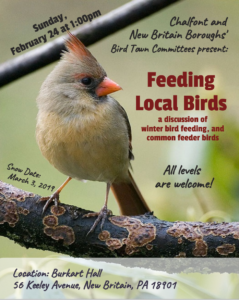
Please see the flyer below for information and details regarding an upcoming entertaining and educational presentation by the New Britain Borough and Chalfont Borough Bird Town programs.
Please join your friends and neighbors on Wednesday, December 5th @ 6:30 PM for the annual Tree Lighting Ceremony along with Santa’s Arrival at the Town Center (Giant Supermarket) in New Britain Borough. At 6:30 PM, CB South’s choir will begin performing. At 7:00 PM, the tree will be lit and Santa will arrive. There will be cookies & hot chocolate, and special gifts for your little ones. Bring your camera and get a photo with Santa! Sponsored by the New Britain Civic Association & Chalfont New Britain Business Alliance (CNBBA).
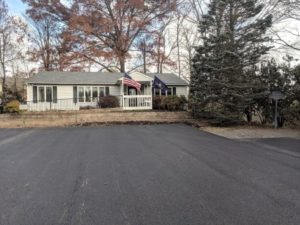 We’re excited to share that the parking lot at our administration building is officially paved! Expect to see parking lines and landscaping added soon! Funding for this project was awarded through a grant from Bucks County through the Community Development Block Grant (CDBG) program.

45 Keeley Avenue, New Britain, PA 18901
© Copyright 2018 All Rights Reserved